PTS is unique in our approach to learning. Our respect for your individuality and our determination to provide a positive, successful experience will give you much pleasure and enhance your life.
What takes place in our brain as we learn with PTS
The creation of music takes place in your imagination and through the making of actual sounds. For you to get the most out of learning how to play the piano/keyboard with PTS, it helps us to have a holistic understanding of how your mind works. PTS courses accommodate the traits of your unique personality in your learning.
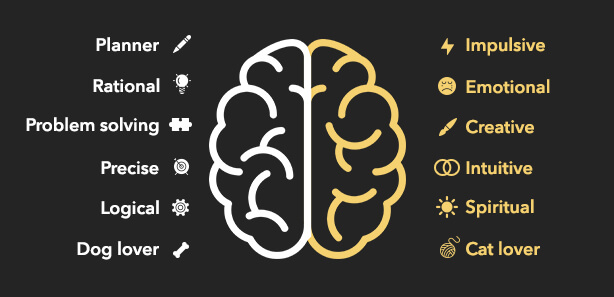
Playing the piano uses both the left (artistic) and right (mathematical) hemispheres of our brain.
Below – what the left and right sides of our brain control.
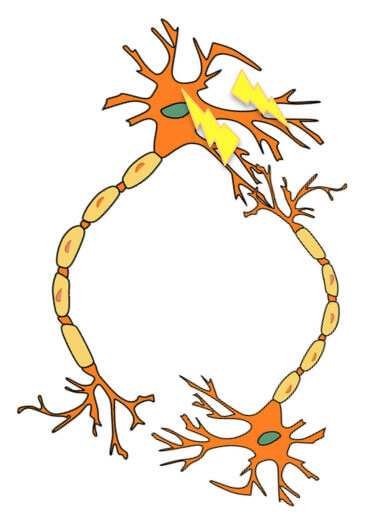
Below– dendrites, neurons and axons. Learning to play the piano shortens the gap allowing for faster and more accurate thought processes and memory retention.
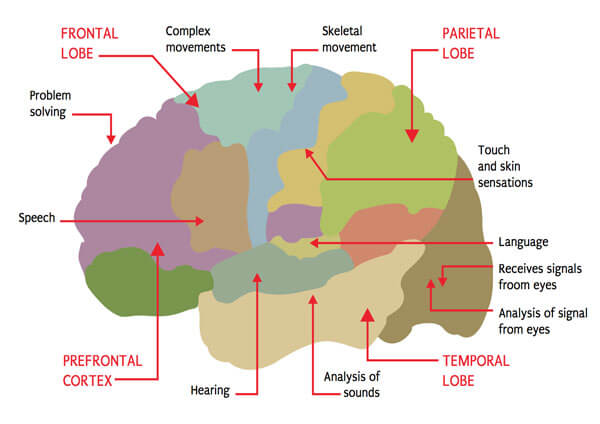
Below – the areas of the brain that we use when playing the piano at PTS.
Brain cells are made up of dendrites and neurons. Electrical messages pass between the nerve cells along the long filaments called axons. Between the cells is a gap called the synapse. These are voluntary cells which means they are responsive to external stimuli. Learning to play the piano lengthens and thickens the axons in both hemispheres (like your bicep would after exercise) decreasing the gap allowing for faster and more accurate thought processes and greater memory retention.
Why PTS uses your personality traits and learning style
PTS uses your dominant learning style and personality traits to plan your lessons. The online lessons have been designed using all the learning styles, i.e. auditory, visual and kinesthetic. Our understanding of your learning style increases our success. Learning style preferences are an aspect of our personality. No one style is more important than another. Preferences simply point to the style you find most beneficial.
PTS will assess which is your dominant personality trait – extrovert, introvert. Are you an activist, a reflector, a theorist or a pragmatist? Take the KEIRSY adult temperament theory quiz.
At PTS we know people will demonstrate a mixture of preferences and we will plan your learning to suit your individual needs. Are you more rhythmic or logical, or do you use sequential reasoning to explore patterns? We take time to assess your dominant way of receiving information and get you to complete the VAK quiz which assesses your perceptual learning style. We use this to help you unravel the beautiful mystery of making music more quickly and easily.
If you are predominantly:
- visual – you will be most comfortable receiving information through reading, writing or seeing (very important to watch the online tutorials for this course)
- auditory – you will more readily remember instructions that are given verbally rather than if written (very important to listen the online tutorials for this course) and recordings of your music
- kinaesthetic – you understand best by doing it and by being physically engaged. Writing out your diagrams is very important for you.
- We will also nurture your less dominant learning styles. This will help you to develop and engage more fully with music.
The benefits of playing the piano for adults with PTS
There is an amazing array of personal benefits to be gained by learning to play the piano with PTS as an adult. For adults, there are both direct physical and mental benefits – it is the equivalent to doing a full body workout for your brain! To play the piano your brain needs to process a lot of information simultaneously – and at great speed. The increased volume and activity in the bridge (corpus callosum) between the left and right hemispheres means that the brain can process information faster, boosting your problem solving abilities academically and socially – we are literally increasing the plasticity of your mind.
Physical benefits of learning to play the piano at PTS include:
- improved coordination and dexterity
- helping to lower blood pressure
- increased cognitive abilities.
Mental health benefits of learning to play the piano with PTS include:
- increased attention to detail
- stronger planning and strategising skills
- understanding non-verbal communication
- increased motivation and efficiency in getting things done
- reduced stressful thoughts as it requires your full attention whilst you are playing
- increased self-esteem and emotional health
- reduced anxiety
- improved patience
- keeping mentally sharp as we age.
Musical education gives you a greater sense of identity by improving your self-image and your self-awareness. It helps you to maintain a positive attitude in life. You will develop sense of accomplishment, have a greater appreciation of music and the arts, learn to have fun with music, value music and develop a creative and social outlet for your self-expression.
Adults who learn piano have the highest scores in their areas of non-verbal visuospatial memory of taking in and adapting new information. These are the skills that let us know our way across the city, or return to somewhere the way we came.
Quite simply, for adults, as little as taking six months of piano lessons with PTS results in increased cognitive function and all the benefits that come from this.
Remember it’s never too late to start making music. PTS will show you how.
Individuals differ in the way they organise their experiences into meaning, value and skills. We react to different delivery styles in different ways. We each need differing amounts of time and practice to internalise learning. PTS enhances your learning experience by accommodating your individual needs.
At PTS we are aware that as adults, we usually find participatory learning most useful. We prefer to have some control over the learning content in order to decide the importance/ priorities of learning for ourselves. Adults wish to set their own pace for learning and we are often task-orientated. We expect the knowledge to be immediately useful.
You have a repository of experience that can be drawn from and to which new learning can be added. You will seek to validate the information against your theories/paradigms and existing knowledge. We will provide you with your individual needs accordingly.
Adults prefer instructional methods that provide variety. PTS uses the following learning tools:
- books
- lectures
- videos and movies – movie soundtracks are a source of great music
- games
- practical tasks
- research activities
- reflection
- discussion
- observation.
Musical genre offered by PTS
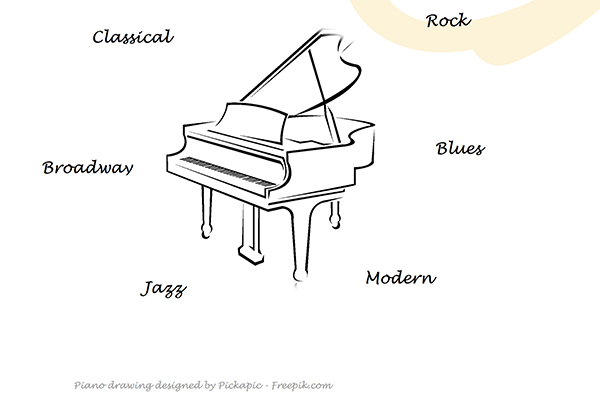
We learn best when we love what we are doing. In the upcoming lessons you will be shown have a taste of different styles of music. What type of music will you enjoy today?